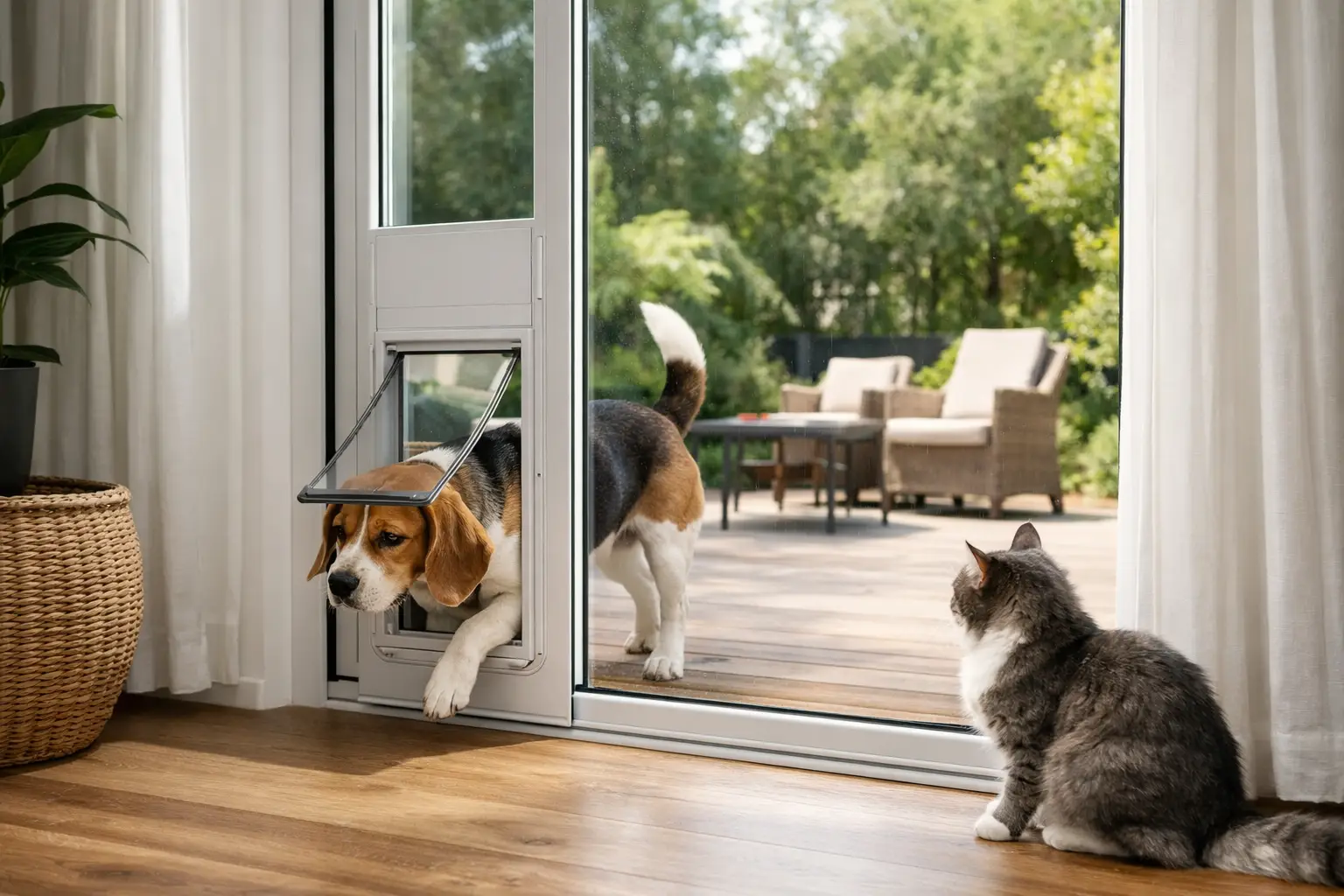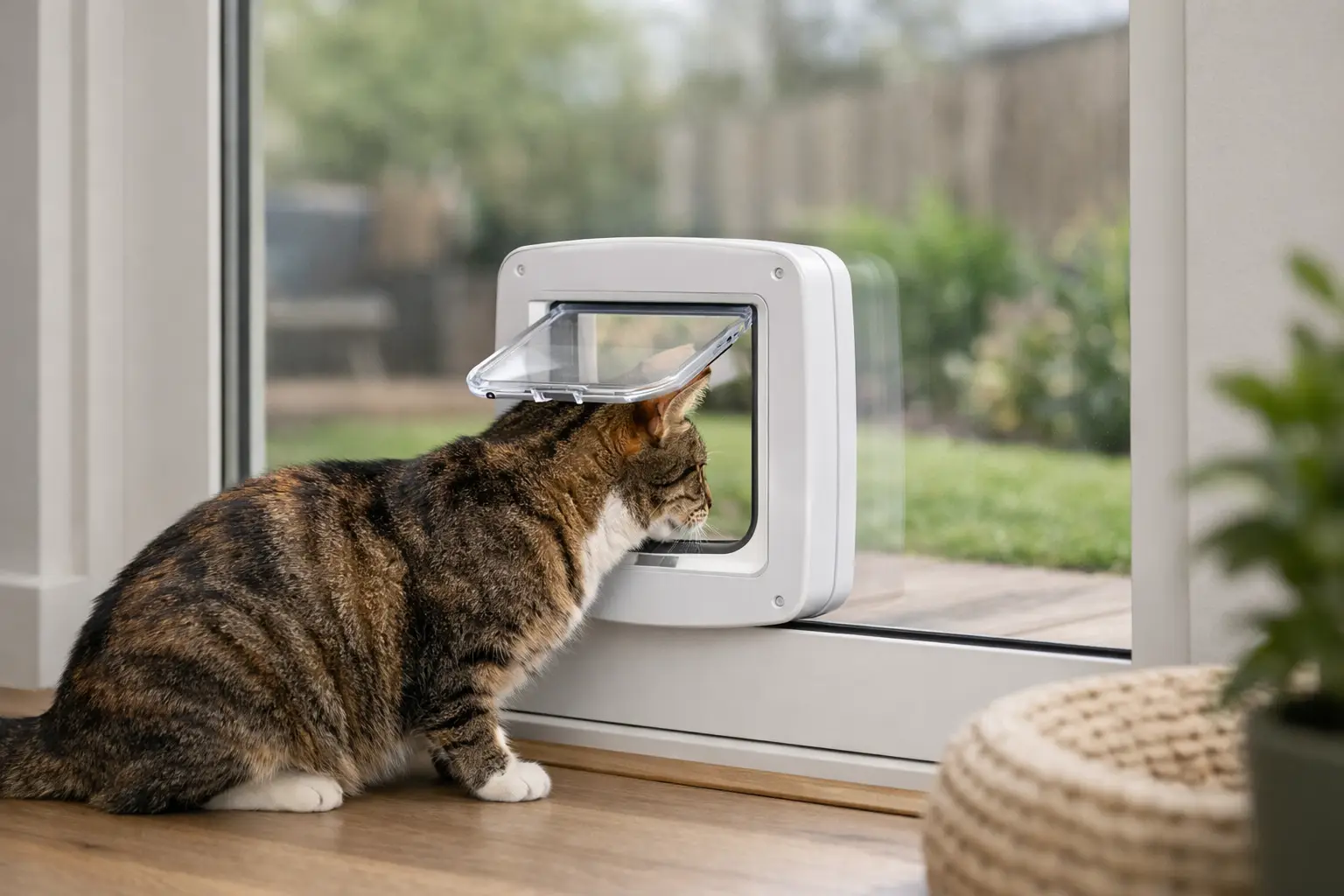
If your dog door is working perfectly for your dog but also giving your cat access you did not intend, you are not alone. One of the most common questions pet owners ask is: how do I keep my cat from using the dog door without locking out the dog?
The answer usually comes down to access control. Standard pet doors are convenient, but they cannot tell the difference between your dog, your cat, or even another animal that can physically fit through the flap. This is where smart pet doors with selective access can be useful.
Selective access pet doors are designed to unlock only for approved pets. Depending on the model, they may work with a microchip, collar tag, electronic key, or app-connected system. For households where one pet should have access and another should not, they can be one of the cleanest long-term solutions.
However, they are not perfect for every home or every pet. Size, power source, Wi-Fi requirements, battery life, installation type, and product availability all matter.
Why standard dog doors do not stop cats
Cats use dog doors for the same reasons dogs do: convenience, curiosity, habit, and access to interesting spaces. If the opening is large enough and the flap is light enough to push through, many cats will keep using it.
Size alone is not always enough to solve the problem. Cats can squeeze through surprisingly small openings, and some are more agile than small dogs. If the dog door was chosen with extra room for comfort, your cat may find it easy to use too.
This is why replacing a standard flap with another standard flap often does not solve the issue. If both pets can physically fit, both pets can usually use it.
What is a selective access pet door?
A selective access pet door is a pet door that only opens for authorised pets. Instead of relying only on the pet pushing through the flap, the door uses some form of recognition before unlocking.
Common options include:
- Microchip pet doors, which read your pet’s implanted microchip
- Collar tag pet doors, which unlock when a matching electronic tag is nearby
- App-connected smart pet doors, which may allow scheduling, activity tracking, or remote locking
- Electronic key systems, where only pets wearing the correct key can enter or exit
For a dog-and-cat household, this means the dog can be given access while the cat is excluded, provided the cat does not also have the recognised chip, tag, or key.
The main benefit: better control
The biggest advantage of a selective access pet door is control. Instead of trying to train your cat not to use the dog door, the door itself controls who can pass through.
This can be useful if you want to:
- Let the dog outside independently
- Keep an indoor cat inside
- Stop one pet from accessing another pet’s area
- Manage feeding routines or toileting habits
- Reduce unwanted outdoor access at night
- Prevent other animals from entering through the flap
For many multi-pet homes, a selective access model is more reliable than training alone. Training can help, but if the door remains physically available, a determined cat may keep testing it.
The trade-offs of smart and selective access pet doors
Smart pet doors can solve a real problem, but they also come with limitations. It is important to choose the product carefully before cutting into a timber door, screen, or glass panel.
1. Some smart pet doors need Wi-Fi
Not all selective access pet doors require Wi-Fi. Some basic microchip or collar tag models work without internet access. However, more advanced smart pet doors may need Wi-Fi for app features such as remote locking, activity logs, scheduling, or notifications.
This can be useful, but it also introduces another thing that needs to work properly. If the Wi-Fi connection is weak near the door, some features may become unreliable. The pet door may still open manually or locally depending on the model, but app-based control may be limited.
Before choosing a Wi-Fi-enabled pet door, it is worth checking whether your signal is strong in the exact location where the door will be installed.
2. Battery life matters
Many selective access pet doors are battery powered. That makes installation easier because the door does not need to be hardwired, but it also means batteries need to be monitored and replaced.
Battery life can vary depending on:
- How often the door is used
- The type of batteries required
- Whether the door is using sensors frequently
- Whether it connects to Wi-Fi or an app
- Weather exposure and temperature
- The size and weight of the locking mechanism
A busy household with pets going in and out all day may use batteries faster than expected. If the batteries go flat, the door may stop unlocking correctly, depending on the model. This can be frustrating if your dog relies on the door for daily access.
For best results, choose a model with a clear low-battery warning and make battery checks part of your routine.
3. Size options can be limited
This is one of the biggest practical issues. Many of the most common selective access pet doors are made for cats or small dogs. They are often designed around microchip access, which is very popular for cat doors.
Larger selective access dog doors are harder to find. If you have a medium or large dog, the range of suitable products may be limited. Some models may not provide an opening large enough for comfortable daily use, while others may be too bulky or unsuitable for glass installation.
This is especially important because a pet door should not be undersized just to stop the cat. Your dog should be able to pass through comfortably without crouching, squeezing, or scraping against the frame.
A door that is too small can cause:
- Reluctance to use the door
- Damage to the flap or frame
- Wear around the dog’s shoulders or back
- Stress or injury over time
- Poor long-term usability
If the dog is larger, selective access may still be possible, but the product choice needs to be checked carefully before installation.
When a smaller dog door helps, and when it does not
Some owners assume the answer is to install a smaller dog door. Sometimes that can help, especially if the dog is clearly larger than the cat in chest width and shoulder height.
But this only works when there is a genuine size difference between the pets. If you have a small dog and a slim or determined cat, reducing the flap size may make life harder for the dog without stopping the cat.
In many cases, a smaller flap is not the best solution. A properly sized selective access door is usually better than forcing the opening to be too small.
Microchip access versus collar tag access
Microchip pet doors can be convenient because your pet does not need to wear anything extra. The door reads the pet’s existing microchip and unlocks for approved animals.
However, many microchip pet doors are smaller and are more commonly designed for cats or small dogs. They may not be suitable for larger breeds.
Collar tag systems can sometimes provide more flexibility, especially where a dog does not have a compatible microchip or where the door uses a specific electronic key. The downside is that your pet must wear the tag consistently. If the collar is removed, lost, or damaged, access can be affected.
Both systems can work well, but the best choice depends on your pet, the door size required, and the installation location.
App-connected smart pet doors: useful, but not always necessary
Some smart pet doors offer app control, timers, curfews, locking modes, and activity tracking. These can be helpful if you want to manage when your pet can go outside or monitor movement during the day.
The downside is that more features can mean more setup, more reliance on Wi-Fi, and more things to maintain. For some households, a simple selective access door without app control may be enough.
The right question is not always “which is the smartest pet door?” It is often “which pet door gives the right access control, in the right size, for the right installation?”
Installation location still matters
Even the best smart pet door needs to be installed in the right place. A poorly placed door can still cause problems.
For example, if the door is near furniture, steps, benches, or climbing points, a cat may have more opportunities to interfere with it. If the exit leads to a high-interest area, the cat may spend more time trying to get through.
Placement also affects how comfortably your dog uses the door. The height should suit the dog’s body, and there should be enough clear space on both sides for safe entry and exit.
Smart pet doors in timber, screens, and glass
The material where the pet door is installed can affect what products are suitable.
Timber doors
Timber doors usually offer the most flexibility. They are often easier to modify, and many pet door models can be installed into timber. This can make timber a good option for upgrading from a standard flap to a selective access door.
Security screens
Security screen installations need more care. The pet door must suit the screen frame and mesh, and the installation should not weaken the screen unnecessarily. Not every smart pet door is suitable for every screen door.
Glass doors and windows
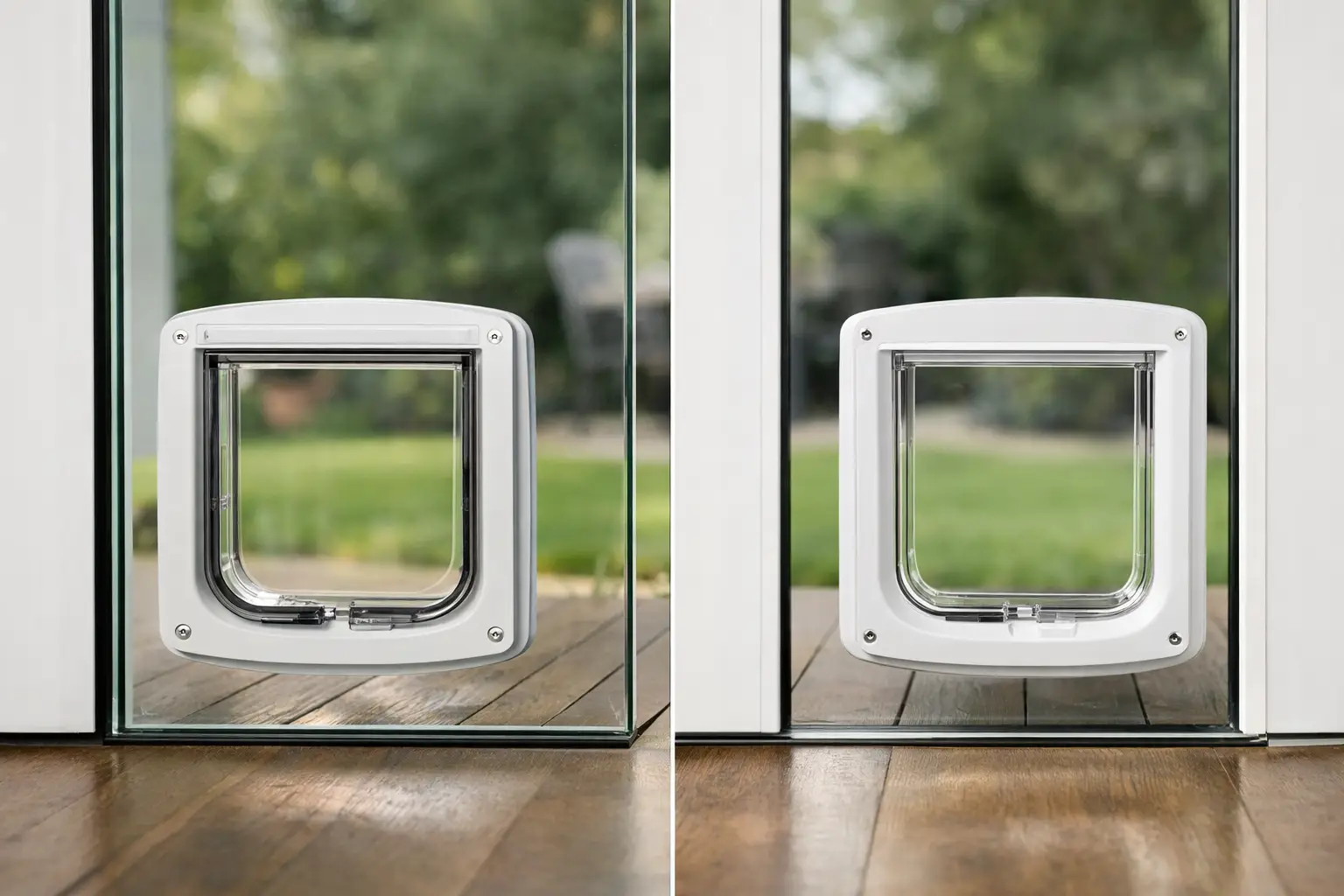
Glass requires specialist handling. Toughened safety glass cannot be cut on site after it has been manufactured. If a pet door is being installed into a glass panel, the glass usually needs to be measured and replaced with a new toughened panel made with the correct opening.
Double-glazed units are more specialised again. The product choice, sizing, and glass replacement all need to be planned before installation. This is especially important with smart or selective access pet doors because the door size and frame dimensions must be correct from the beginning.
There is a limited range of selective entry pet doors suitable for glass installation. And they are generally not suitable for glass sliding doors due to their thicker profile.
The pros of selective access pet doors
Selective access pet doors can offer:
- Better control over which pet can use the door
- A practical way to keep indoor cats inside
- Less reliance on constant supervision
- More independence for the authorised pet
- Better management in multi-pet homes
- Extra protection against unwanted animal entry
- Optional smart features such as schedules and app controls
For many households, these benefits make daily life much easier.
The cons of selective access pet doors
The main downsides are:
- Higher cost compared with standard pet doors
- Fewer size options, especially for larger dogs
- Possible Wi-Fi requirements for smart features
- Ongoing battery maintenance
- More setup than a basic flap
- Collar tags can be lost or damaged
- Some models may not suit glass, screens, or larger pets
- Product availability may limit your choices
These issues do not mean selective access doors are a bad choice. They simply mean the product needs to be matched carefully to your home and pet.
What works best for most multi-pet homes?
For many households, the best solution is a selective access pet door that is:
- Correctly sized for the authorised pet
- Installed in a suitable location
- Compatible with the door, screen, or glass panel
- Practical to maintain
- Not overly reliant on features you do not need
If you have a small dog and an indoor cat, there may be several suitable selective access options. If you have a larger dog, the choices may be more limited and will need more careful planning.
In some cases, the best answer may not be the most advanced smart door. It may be the model that offers reliable access control in the correct size.
Final thoughts
If your cat keeps using the dog door, the problem may not be your training. It may be that the door was never designed to tell pets apart.
Smart pet doors with selective access can be a practical solution, especially in homes where one pet needs freedom and another needs boundaries. They can help keep the dog’s routine easy while stopping the cat from treating the dog door like its own private exit.
The key is choosing the right product before installation. Wi-Fi access, battery life, pet size, opening dimensions, and installation type all need to be considered. This is especially important for larger dogs, because the range of selective access pet doors is more limited than it is for cats and small pets.
At Pet Doors Ontime, we help homeowners choose pet door solutions that suit their pets, their property, and the way they actually live. A good pet door should make life easier, not create a daily negotiation between you, the dog, and a very determined cat.
Need a pet door installed? Go to www.petdoorsontime.com